With AI agents becoming part of my daily routine, I increasingly shifted my research focus towards how we discover, understand, and communicate intent.
Intent is fundamental to how we think and act, both individually and collectively. We continuously try to understand what we want to achieve, articulate it to ourselves and others, and interpret the intentions behind others' actions. With the fast improvement of AI agents that are increasingly capable of acting on our behalf, I find that understanding and communicating intent becomes where most of our time goes.
Communication was not the problem
I first started looking into it naively, considering it a communication problem. Any smart-enough AI agent, say Codex, would seem capable of doing what I wanted, and still fail at it miserably. With the AI agents improving, I increasingly found myself attributing those still frequent failures to my inability to express clearly what I wanted, rather than blaming the AI agent for being dumb.
Eventually, I realized I often did not know my intent in the first place. It's like having a rough idea of an image in your mind, without the details. When you picture it better, for instance drawing (or generating) it, you then realize that's not really the image you actually wanted. In the process you have sharpened your intent, and when the work is done by an AI agent, now it suddenly feels like the AI agent failed at the task. Seldom do we realize it is our understanding of what good looks like that changed.
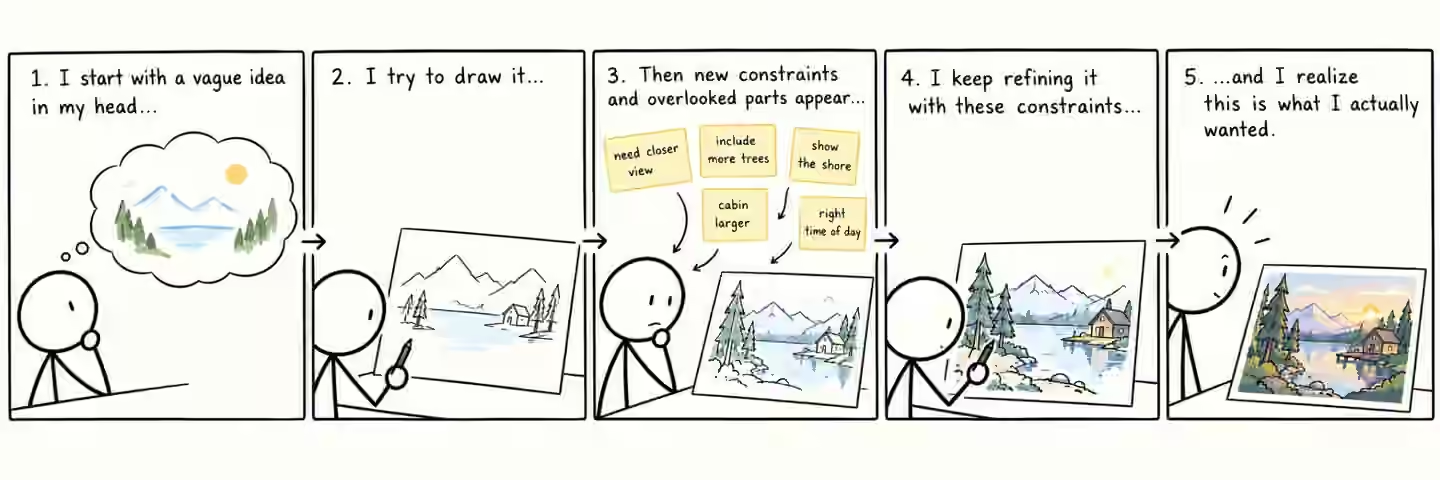
Intent is shaped through the process of trying to realize it, redefining our initial understanding.
Like many others with a career in computer science, my first area where this became apparent was coding. Interestingly, I realized I was using something specifically developed to drive AI agents' execution as a tool for intent discovery. In fact, some time ago people were going all-in with something called plan mode, because it would allow their coding agents to be more effective.
The wrong reason to use plan mode
I used plan mode and never understood the excitement. It appeared to me a step back: I had to look into the details of what the agent was planning to do, instead of just receiving and validating the outcome of its work. But it was somehow helpful, mostly for my understanding of what I wanted to build.
That is, the coding agent's plan forced me to see the many faces of my stated goal, which otherwise I ignored or overlooked. For me it was never about the plan, but rather, the plan was showing me how to better understand my intent and its inherent complexity (or simplicity!).
Discovery and Delivery
This is also why I used plan mode only for a short time, and quickly switched to something I called the discovery/delivery cycle. I would structure any significant development task with a coding agent into two distinct phases:
- Discovery: focus on understanding the intent, what is hidden, overlooked or unsaid. The goal is to specify the goal in its multi-faceted set of features, constraints and implications.
- Delivery: focus on tracing progress, provide what's needed for the coding agent to be effective (including a plan)... and mostly ignore all of it unless you need auditing, verification or troubleshooting! The docs of the delivery phase are essentially the coding agent's scratchpad (and the handoff doc, for the time when compaction wasn't working).
For a few months in 2026, the discovery/delivery cycle became a common practice in my group, since it was working well not just for me, but also for my colleagues (yes, I am aware that if the group lead suggests it, group members are biased to use it).
Generalizing to unseen samples
Turns out that the discovery/delivery cycle works well in other areas too. For instance, in my re-ignited passion for building worlds, narratives and interactive experiences.
For a number of reasons I ended up reviving an old passion of mine about world building a couple of years ago. With AI agents becoming better at 3D and so many people showing cool examples, I could not avoid trying it myself.
Like with coding, my undirected prototypes were cool, but anything that needed to match my intent became significantly harder to achieve. I was unable to clearly see my intent, and I was unable to clearly communicate it.
What unifies all tasks
Coding and world building partly exercise similar thinking paths, but the means, the context and the tasks feel quite different. Still, I find I had the same need with both: I needed to see what I was creating to understand what I actually wanted to build.
In code, the discovery phase would get me thinking about architectural components, the functional parts needed for my half-stated goal and non-functional constraints. I could see the parts coming together and through them understand what I missed in my original intent.
In 3D world building, I needed to see a spatial composition to visualize the vague image in my head, and connect the dots for my visual storytelling.
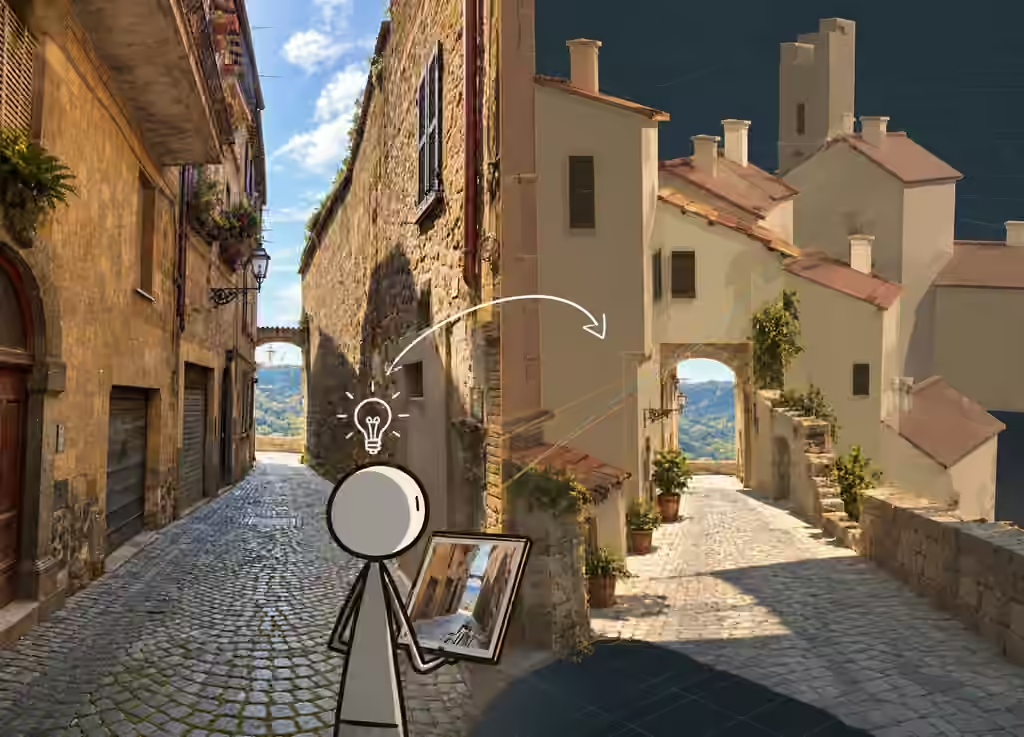
In visual storytelling, spatial composition enables sharpening the narrative intent.
Where are we heading to?
I have been speaking of intent discovery because it is the often overlooked part of the process. Nonetheless, we really have three states:
- Undiscovered intent: I have yet to understand what I want, I need to learn more to find out.
- Underspecified intent: I have a general idea, but didn't work out the details.
- Unexpressed intent: I know what I want, but struggle to communicate it.
I find myself moving continuously through these three states, and spending most of my time in transitioning from one to the other, or addressing the specific issues that come within each of them.
Not long ago, I would have spent most of my time in building my ideas, with some of these issues clearing themselves naturally through the building process itself.
With AI agents becoming increasingly capable of doing the building, our time inevitably shifts away from execution. Perhaps it is time to think more carefully about how AI agents evolve from tools that assist execution into tools that help us (or sometimes shape and guide us*) to discover and develop our intentions.
Needless to say, this has significant implications in cybersecurity and cognitive security.